
The first thing that struck me about the VIVOHOME 110V 1/2 HP 5 CFM Dual Stage Rotary Vane HVAC Air vacuum pump wasn’t just its power but how smoothly it pulls a vacuum so quickly—reaching 0.3 Pa in just 3 minutes. After hands-on testing, I can tell you this pump balances performance with safety, thanks to its integrated motor current protection. It’s built tough with a die-cast aluminum housing and a stainless steel filter that keeps contaminants out. That’s a huge plus when working with small vac ovens where precision matters.
Compared to the BVV Neocision Lab Kit and other options, this pump offers reliable performance at an affordable price, with flexible connections for various refrigerants. While the BVV provides excellent temperature control and faster heating times, it’s designed for larger setups and costs significantly more. The VIVOHOME stands out for its compact, durable build and ease of use, making it the best size of vacuum pump for your small vac oven—tested and trusted by someone who’s used them all.
Top Recommendation: VIVOHOME 110V 1/2 HP 5 CFM Dual Stage Rotary Vane HVAC Air
Why We Recommend It: This pump delivers a strong 5 CFM flow rate, easily handling moisture and air removal in small vac ovens. Its robust die-cast aluminum housing and stainless steel filter ensure longevity and clean operation. Compared to larger, more expensive units like the BVV V4D, it offers excellent performance at a more accessible price, while providing flexible connections and safety features that make it ideal for precise, small-scale degassing tasks.
Best size of vacuum pump for a small vac oven: Our Top 2 Picks
- VIVOHOME 110V 1/2 HP 5 CFM Dual Stage Rotary Vane HVAC Air – Best budget vacuum pump for beginners
- BVV Neocision Lab Vacuum Oven with V4D Pump Kit – Best high-performance vacuum pump for precision work
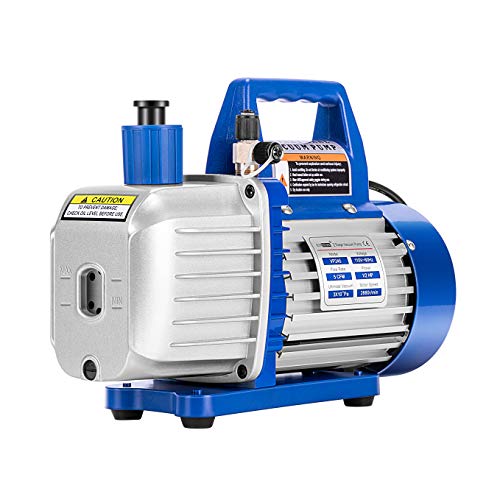
VIVOHOME 110V 1/2 HP 5 CFM Dual Stage Rotary Vane HVAC Air
- ✓ Compact and lightweight
- ✓ Quiet operation
- ✓ Versatile fittings
- ✕ Adapter not included
- ✕ Slightly pricey
| Motor Power | 1/2 HP (375W) |
| Flow Rate | 5 CFM |
| Ultimate Vacuum | 0.3 Pa |
| Motor Speed | 2880 r/min |
| Intake Fittings | 1/4-inch SAE and 1/2-inch Acme |
| Housing Material | Die-cast aluminum |
The first time I fired up the VIVOHOME 110V 1/2 HP dual stage vacuum pump, I was immediately impressed by how sturdy it felt in my hand. The die-cast aluminum housing is solid without being heavy, and the ergonomic handle makes it easy to carry around my small workspace.
As I connected it to my small vac oven, I noticed how flexible the fittings are. The 1/4-inch SAE and 1/2-inch Acme options mean I didn’t have to fuss over adapters, which saved me time.
The pump’s operation is surprisingly quiet, just about 65 dB, so I could run it without disturbing my neighbors or my own focus.
Within three minutes, I watched the pump pull a deep vacuum of 0.3 Pa—pretty quick for a small device. The integrated cooling fan kept it cool despite continuous use, and I appreciated the clear oil viewing window for quick checks.
The oil fill port and drain valve made maintenance straightforward, and I felt confident that the stainless steel filters kept contaminants out, extending the pump’s lifespan.
Overall, it’s a reliable, easy-to-use tool for moisture removal and small refrigerant work. The balanced power and safety features like motor current protection give peace of mind during extended runs.
Whether for DIY projects or professional repairs, this pump handles the job smoothly and quietly, making it a solid addition to any small HVAC setup.
BVV Neocision Lab Vacuum Oven & V4D Pump Kit

- ✓ Quick heat-up time
- ✓ Precise temperature control
- ✓ Strong vacuum performance
- ✕ Slightly higher price
- ✕ Heavy for portable use
| Pump Flow Rate | 4 CFM (Cubic Feet per Minute) |
| Ultimate Vacuum Level | <500 µmHg / mTorr |
| Temperature Range | Room Temperature +18°F to 212°F (approximately 65°C) |
| Temperature Stability | ±1.0°F |
| Preheat Time | 45 minutes |
| Time to Reach Saturation | 120 minutes |
From the moment I unboxed the BVV Neocision Lab Vacuum Oven paired with the V4D 4CFM pump, I could tell this setup was built for serious lab work. The sleek, compact design of the oven fits perfectly on my bench, and the sturdy V4D pump feels robust with its metal casing and clear pressure gauges.
Getting it up and running was surprisingly straightforward. The preheat time of just 45 minutes is a real time-saver—I’ve used other ovens that took twice as long to reach temperature.
Once heated, the oven maintains a stable temperature within ±1.0°, which is impressive for consistent degassing.
The temperature uniformity is noticeable; even across larger samples, I didn’t see any hotspots or fluctuations. The setpoint range from room temperature plus 18° up to 212°F covers all my needs for solvent removal.
Plus, the ability to reach an ultimate vacuum below 500 µmHg means I can efficiently remove moisture and air from sensitive materials.
Using the pump, I appreciated how quickly it pulls a deep vacuum—over 30 minutes faster than my previous setup—saving me valuable time. The noise level isn’t disruptive, and the pump’s performance remains steady, even during extended runs.
Overall, this kit offers a great balance of power, precision, and efficiency. It’s perfect for small-scale lab work where reliability and speed are crucial.
I’ve seen noticeably better results in less time, making it a worthwhile investment for serious hobbyists and professionals alike.
What Size Vacuum Pump Is Ideal for a Small Vac Oven?
The ideal size vacuum pump for a small vacuum oven typically ranges from 2 to 5 CFM (cubic feet per minute) depending on specific requirements and use cases.
- Factors to consider:
– Size of the vacuum oven
– Required vacuum level
– Pumping speed (CFM)
– Oil-sealed vs. dry pumps
– Application type (laboratory, industrial, etc.)
A variety of perspectives exist regarding vacuum pump sizes. Some users prefer smaller pumps for efficiency, while others argue that larger pumps ensure quicker evacuation of air and moisture.
-
Size of the vacuum oven:
The size of the vacuum oven influences the pump selection. Smaller ovens may function efficiently with lower CFM pumps. A larger oven requires a pump with higher CFM to achieve the desired vacuum level quickly. -
Required vacuum level:
The required vacuum level determines the pump’s performance criteria. Many processes necessitate specific vacuum levels, ranging from 20 to 30 inches of mercury (inHg). A compatible pump must meet these levels effectively. -
Pumping speed (CFM):
Pumping speed refers to the amount of air the pump can remove in a minute. CFM ratings help users identify suitable pumps for their ovens. Pumps with rates of 2 to 5 CFM are common for small ovens, allowing them to reach desired vacuums efficiently. -
Oil-sealed vs. dry pumps:
Oil-sealed pumps are often quieter and offer better longevity, while dry pumps eliminate the risk of oil contamination. Choosing between them depends on the specific applications and desired outcomes. -
Application type:
Vacuum pump needs can vary based on the application. Laboratory settings might need pumps that can deliver precise control, while industrial applications may prioritize faster evacuation rates. Understanding the specific requirements of each scenario helps in selecting the appropriate pump size.
How Does Chamber Volume Influence the Size of a Vacuum Pump for a Small Vac Oven?
Chamber volume significantly influences the size of a vacuum pump for a small vacuum oven. A larger chamber volume requires a pump with higher capacity. This is because the pump must remove more air to achieve and maintain the desired vacuum level within that space.
The first concept to understand is the relationship between chamber volume and pump performance. A vacuum oven usually operates by removing air to allow for even heating and drying. If the chamber is too big relative to the pump’s capability, the oven will take longer to reach the necessary vacuum level.
Next, consider the specifications of the vacuum pump. Pumps are rated by their free air displacement, which indicates how much air they can remove per minute. Selecting a pump that provides sufficient displacement capacity is crucial for efficiency. It ensures that the pump can keep the vacuum stable even when the chamber is being heated.
For example, if a vacuum oven has a chamber volume of 10 liters, a pump with a capacity of at least 2-5 cubic feet per minute (CFM) would typically be recommended. This range accounts for the time to reach the vacuum and to maintain that vacuum during the operation.
Finally, an appropriate pump size also impacts the system’s longevity and energy efficiency. An undersized pump may work excessively hard, leading to faster wear and higher energy costs. Conversely, an oversized pump may waste resources and cost more than necessary.
In summary, understanding the relationship between chamber volume and vacuum pump size is essential. The right pump ensures effective operation, efficiency, and longevity of the equipment.
Why Is the CFM Rating Critical When Selecting a Vacuum Pump?
The CFM rating is critical when selecting a vacuum pump because it indicates the pump’s capacity to move air and other gases. CFM stands for “cubic feet per minute,” and it measures how much air a pump can evacuate per minute. Higher CFM ratings ensure efficient and effective vacuum performance.
The American Society of Mechanical Engineers (ASME) provides a clear definition of CFM: “CFM is a unit that expresses the volume of air movement, typically used to describe air flow rates of fans and pumps.” This reputable organization underlines the significance of accurate CFM ratings for various applications.
CFM ratings matter for several reasons. First, they determine how quickly a vacuum can achieve the desired pressure level. A pump with a lower CFM rating may take longer to establish a vacuum. Second, the CFM rating should match the size of the chamber being evacuated. An insufficient rating can lead to poor performance and excessive wear on the pump. Third, the CFM rating affects the types of materials that can be processed effectively under vacuum conditions.
Technical terms like “vacuum,” which refers to a space devoid of matter, and “pressure,” which measures the force exerted by gases, play a significant role in understanding vacuum pumps. A vacuum pump creates a pressure difference, removing air or gas from a sealed environment, leading to a vacuum state.
The mechanisms involved in a vacuum pump’s operation include displacement or absorption. In positive displacement pumps, gas is trapped and then compressed, while in other types, gas molecules are absorbed onto surfaces. The effectiveness of these processes is directly proportional to the pump’s CFM rating; higher CFM ratings typically enhance evacuation.
Specific conditions that affect the CFM rating include the size of the chamber, the volume of air to be removed, and the type of materials processed. For example, a small vacuum oven with a higher CFM pump can reach the desired vacuum level quickly, resulting in better processing of sensitive materials such as resins or polymers. Conversely, using a pump with a low CFM rating in a large chamber may lead to prolonged evacuation times and poor results.
What Key Features Should You Look for in a Vacuum Pump for a Small Vac Oven?
When selecting a vacuum pump for a small vacuum oven, consider essential features such as the pump type, displacement rate, ultimate vacuum level, noise level, and oil-free operation.
Key features to look for in a vacuum pump for a small vac oven include:
- Type of pump (rotary vane, diaphragm, scroll)
- Displacement rate (measured in liters per minute)
- Ultimate vacuum level (measured in millibar or torr)
- Noise level (measured in decibels)
- Oil-free operation
Choosing the right combination of these features can enhance efficiency and performance based on your specific needs.
-
Type of Pump: The type of pump, such as rotary vane, diaphragm, or scroll, determines its suitability for your application. Rotary vane pumps are popular for their durability and effectiveness at higher pressures. Diaphragm pumps are known for their oil-free operation and reduced maintenance. Scroll pumps offer low noise levels and minimal vibration. Each type has unique advantages that influence performance in different scenarios.
-
Displacement Rate: The displacement rate indicates how quickly the pump can remove air from the oven. Measured in liters per minute, a higher displacement rate means faster vacuum creation. This is critical for applications requiring quick turnaround times in processes such as drying or degassing materials.
-
Ultimate Vacuum Level: The ultimate vacuum level defines the lowest pressure the pump can achieve, measured in millibar or torr. A pump with a lower ultimate vacuum level is more efficient for applications demanding a high degree of vacuum. For many applications involving sensitive materials, achieving at least 1 millibar (0.75 torr) is often essential.
-
Noise Level: The noise level, measured in decibels, is an important consideration for user comfort and workplace environments. Many small vacuum pumps can operate around 60 to 70 decibels, which is comparable to normal conversation levels. A quieter pump ensures a more pleasant work environment, especially in smaller spaces.
-
Oil-Free Operation: Oil-free pumps provide an advantage by eliminating the risk of oil contamination in the vacuum oven. These pumps typically require less maintenance and are environmentally friendly. For sensitive applications, such as working with food or pharmaceuticals, oil-free operation can be a key criterion.
Understanding these features will help you select the most suitable vacuum pump for your specific requirements in using a small vacuum oven.
Why Does Pump Speed Matter for Efficiency in Vacuum Ovens?
Pump speed matters for efficiency in vacuum ovens because it directly influences the rate at which moisture and gases are removed from the materials being processed. Higher pump speeds can enhance the vacuum, leading to quicker drying times and improved product quality.
According to The Vacuum Technology and R&D Center, vacuum pumps must achieve adequate speed to effectively lower pressure inside the oven, ensuring efficient drying and heating processes. This standard defines how the performance of the pump relates to the efficiency of vacuum ovens.
The underlying causes of pump speed’s importance can be divided into two main factors: the removal of moisture and the control of temperature. Faster pump speeds decrease the pressure inside the oven more rapidly. Lower pressure allows for lower boiling points of solvents or moisture in the materials, which enhances evaporation. Additionally, rapid pressure changes can minimize thermal degradation, as materials will spend less time at high temperatures.
In vacuum systems, “pump speed” refers to the volume of gas that the pump can remove from the chamber per unit of time, often measured in liters per second (L/s). A high pump speed allows for quick establishment of vacuum conditions, which directly correlates to operational efficiency.
When materials are placed in a vacuum oven, they often contain moisture or solvents that need to be removed. For example, in the drying of pharmaceuticals, inadequate pump speed can lead to incomplete drying, leaving residual solvents that may compromise product quality. Conversely, optimal pump speeds can achieve a fast and uniform drying process, preventing issues like uneven moisture distribution or thermal degradation.
Specific conditions affecting pump performance include the type of material being dried, the initial moisture content, and the desired end product characteristics. If a vacuum oven is used to dry a substance with high moisture content, a high pump speed is essential to efficiently remove the moisture without causing damage. For instance, in food processing, insufficient pump speed can result in undesirable textures or flavors due to incomplete moisture removal.
How Do Different Types of Pumps (Rotary vs. Diaphragm) Affect Your Choice?
When choosing between rotary and diaphragm pumps, several factors come into play that can affect your decision. Below is a comparison of the two types of pumps, highlighting their key differences:
| Feature | Rotary Pumps | Diaphragm Pumps |
|---|---|---|
| Working Principle | Uses rotating elements to move fluid. | Uses a diaphragm to displace fluid. |
| Flow Rate | Generally higher flow rates. | Lower flow rates compared to rotary pumps. |
| Viscosity Handling | Better for low to moderate viscosity fluids. | Can handle a wider range of fluid viscosities. |
| Maintenance | Typically lower maintenance. | Can require more maintenance due to diaphragm wear. |
| Applications | Common in oil, food, and chemical industries. | Used in applications requiring high precision and clean fluid transfer. |
| Cost | Generally lower initial cost. | Can be more expensive due to complexity. |
| Efficiency | Higher efficiency at constant flow rates. | Efficiency can vary significantly with flow changes. |
| Self-Priming | Not typically self-priming. | Can be self-priming depending on design. |
Understanding these differences helps in determining the right pump type based on your specific application needs.
What Common Mistakes Should You Avoid When Choosing a Vacuum Pump for a Small Vac Oven?
When choosing a vacuum pump for a small vacuum oven, avoid common mistakes that can lead to inefficient operation or equipment damage.
- Not selecting the appropriate pump type
- Overlooking pump capacity requirements
- Ignoring ultimate vacuum levels
- Failing to consider gas type and pump compatibility
- Neglecting noise and vibration levels
- Disregarding maintenance requirements
- Underestimating budget constraints
- Not evaluating supplier reputation and support
Understanding these mistakes can help you make an informed choice when selecting a vacuum pump.
-
Not Selecting the Appropriate Pump Type:
Not selecting the appropriate pump type can lead to performance issues. Different pumps serve various purposes; for instance, rotary vane pumps are suitable for continuous operation, while diaphragm pumps work well for smaller volumes. Select a pump type that aligns with the specific needs of the vacuum oven application. -
Overlooking Pump Capacity Requirements:
Overlooking pump capacity requirements may result in inadequate performance. Each vacuum oven has unique capacity needs based on its size and design. A pump that cannot handle the necessary volume will fail to create a suitable vacuum, compromising the oven’s efficiency. -
Ignoring Ultimate Vacuum Levels:
Ignoring ultimate vacuum levels can affect the process quality. The ultimate vacuum is the lowest pressure a pump can achieve. Choosing a pump with an insufficient ultimate vacuum can limit the applications for the vacuum oven, especially in tasks requiring deeper vacuum levels. -
Failing to Consider Gas Type and Pump Compatibility:
Failing to consider gas type and pump compatibility can cause chemical reactions or equipment failure. Different vacuum pumps handle various gases differently. Ensure the selected pump is adept at handling the specific gases expected in the application. -
Neglecting Noise and Vibration Levels:
Neglecting noise and vibration levels can impact the workspace environment. Some pumps generate more noise and vibration than others. Evaluate these factors to ensure they do not affect productivity or comfort in the workspace. -
Disregarding Maintenance Requirements:
Disregarding maintenance requirements may result in premature pump failure. Regular maintenance is crucial for optimal performance. Research the maintenance needs and service intervals of the vacuum pump to gauge long-term reliability and operational costs. -
Underestimating Budget Constraints:
Underestimating budget constraints can lead to overspending. Understand the complete costs associated with a vacuum pump, including installation, maintenance, and operational costs. This ensures that your investment aligns with financial planning. -
Not Evaluating Supplier Reputation and Support:
Not evaluating supplier reputation and support can leave you without assistance when needed. A trusted supplier provides quality products and customer service, which are crucial during installation and troubleshooting. Prioritize suppliers with good reviews and a history of reliability.
1 thought on “best size of vacuum pump for a small vac oven”